The Boring Gear That Might Actually Save Your Life Out There
Scroll through any van build reveal and you'll see the same sequence: the cabinetry, the countertop, the ambient lighting, maybe a drone shot of the van parked at a scenic overlook. What you won't see is the carbon monoxide detector mounted low near the floor, the satellite communicator clipped to the dash, or the fire suppression system tucked under the cooking area.
That stuff doesn't get likes. But it gets people home.
This isn't a scare piece. Van life is genuinely safe when you build and prepare thoughtfully. But there's a real gap between builds that look great and builds that are actually ready for the situations that don't make it onto the feed. Here's what fills that gap.
Carbon Monoxide: The Invisible Problem
CO poisoning in enclosed vehicles is more common than most people realize, and it doesn't always come from an obvious source. Propane appliances that aren't burning cleanly, a generator running too close to a vent, or even exhaust from a nearby idling vehicle can push CO levels into dangerous territory while you sleep.
The fix is cheap and simple: a low-placement CO detector rated for RV or marine use. Standard household detectors are calibrated for larger spaces and may not catch lower concentrations that are still dangerous in a small van. Look for units with a digital readout so you can actually monitor levels, not just wait for the alarm.
Mounting location matters. CO is slightly lighter than air but tends to accumulate at breathing level in enclosed spaces. Mount it somewhere you'll see or hear it easily from your sleeping position.
Satellite Communication When Cell Service Disappears
If you're spending any real time in remote areas — and most serious van lifers are — a satellite communicator isn't a luxury. It's the difference between a bad situation and a catastrophic one.
Devices like the Garmin inReach Mini or the SPOT X give you two-way messaging and SOS capability anywhere on Earth. They're subscription-based, and yes, the annual cost adds up. But consider the math: one genuine emergency in a location with no cell service, and that device pays for itself a hundred times over.
Beyond emergencies, satellite communicators are useful for checking in with family, getting weather updates in areas with no signal, and navigating genuinely remote terrain with confidence. A lot of van lifers treat them as unnecessary until they need them. The ones who've actually needed them treat them as non-negotiable.
Fire Suppression That Actually Works in a Van Context
A standard kitchen fire extinguisher is fine, and you should absolutely have one. But there's a second layer worth considering: automatic fire suppression systems designed for vehicle engine compartments and cooking areas.
Systems like the Amerex or Kidde vehicle suppression setups can be installed in your engine bay and activate automatically if temperatures spike. For the cooking area, there are compact automatic suppression canisters that mount above your stove and discharge if a fire reaches them — no human reaction time required.
This matters in a van because the sleeping and cooking areas are the same room. A grease fire at 2 AM in a vehicle is not the same situation as a kitchen fire in a house where you can close a door and evacuate. Response time is everything, and automatic systems don't need you to wake up first.
Redundant Power for the Systems That Keep You Safe
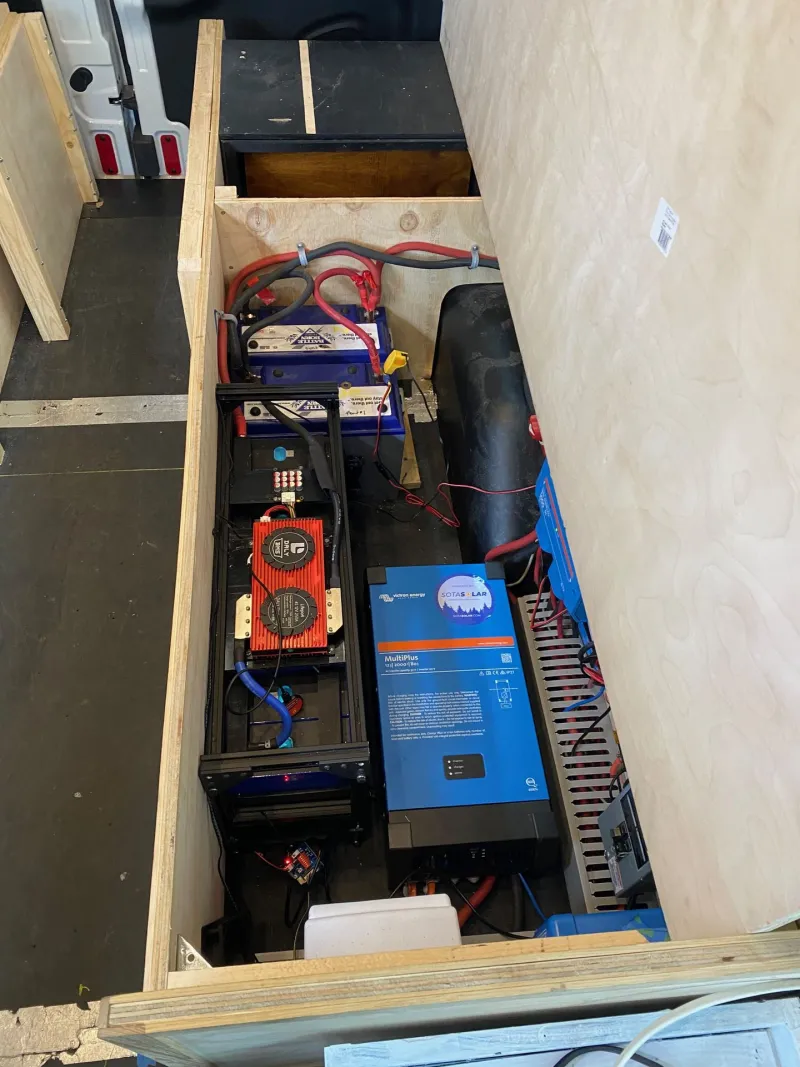
Most van builds have a primary lithium or AGM battery bank running the lights, fridge, fan, and devices. What fewer builds have is a true backup power source for safety-critical systems.
The idea is simple: if your main bank fails or gets accidentally drained, you want your CO detector, your communication device, and your ventilation fan to still work. A small dedicated backup battery — even a modest 20Ah unit isolated from the main system — wired only to those critical systems provides meaningful redundancy without a huge investment.
This also applies to lighting. A headlamp is obvious, but a hardwired emergency LED strip on its own circuit gives you visibility to troubleshoot or evacuate without draining your main bank.
Tire Pressure Monitoring Systems
Blowouts on highway speeds are genuinely dangerous, and they're often preventable. A tire pressure monitoring system (TPMS) gives you real-time readouts for all four tires and alerts you when pressure drops or temperature spikes — both early warning signs of a tire that's about to fail.
Aftermarket TPMS kits run $50–$150 and install in about 20 minutes. They're not exciting. They don't change the look of the build. But a blowout on a loaded van at 70 mph on I-40 is a different animal than a blowout on a passenger car, and knowing your tires are healthy before that situation develops is genuinely valuable.
The First Aid Kit You Actually Know How to Use
Every van has a first aid kit. Most of them are the $12 variety from a big box store that gets shoved in a cabinet and never opened. That's not useless, but it's not enough if you're regularly spending time in remote areas.
A more useful approach: take a Wilderness First Aid course (they're typically a weekend, widely available across the US, and run around $200–$300), then build or buy a kit that matches what you actually learned. Knowing how to manage a wound, recognize signs of altitude sickness, or stabilize a sprain in a remote setting is a skill set that costs you a weekend and pays off indefinitely.
The gear matters less than the knowledge. But having both is the move.
Build for the Moments You Don't Post About
The best van builds are the ones that handle the unsexy moments as well as they handle the scenic overlook. A van that looks incredible but has no CO detection, no backup communication, and no fire suppression is a risk dressed up as an adventure.
The upgrades in this piece won't make your build photos any more compelling. But they'll make the thing you built actually worth trusting when it's all you've got.